

The calm switch in your body—and how to use it
How to improve “vagal tone” (without influencer nonsense)

Heads up: I’m doing an intimate, interactive event in NYC on May 17 at 92NY. Small room, live Q&A, and a chance to ask me anything about anxiety, self-criticism, and how to feel less alone. Limited seats. Get tickets here.
And stay tuned for Sleep Week kicking off Mother’s Day, May 10 — six days of sleep-focused content, 10 new sleep meditations, a sleep-centered live session with Teacher of the Month Cara Lai, podcast episodes featuring some of the world’s leading sleep experts, and a community coming together around something we all need more of. Only in the 10% with Dan Harris app. Sign up here.
As someone who is both anxious and skeptical, I am always looking for non-bullshit ways to boost my calm quotient. Lately, I’ve become increasingly interested in something called “vagal tone.”
Depending on how you have (consciously or subconsciously) trained the algorithms, you might’ve seen a lot of influencer content about training your vagus nerve. Some of this stuff is dubious, but it turns out there’s actually a valuable nugget of truth, too.
The vagus nerve is a long wandering nerve that runs from the brain down through the heart, lungs, and gut, helping regulate key functions involved in stress and recovery. It’s a major player when it comes to shifting out of fight-or-flight mode and into a more settled state. And there’s growing evidence you may be able to strengthen this system—sometimes called improving vagal tone—through simple practices.
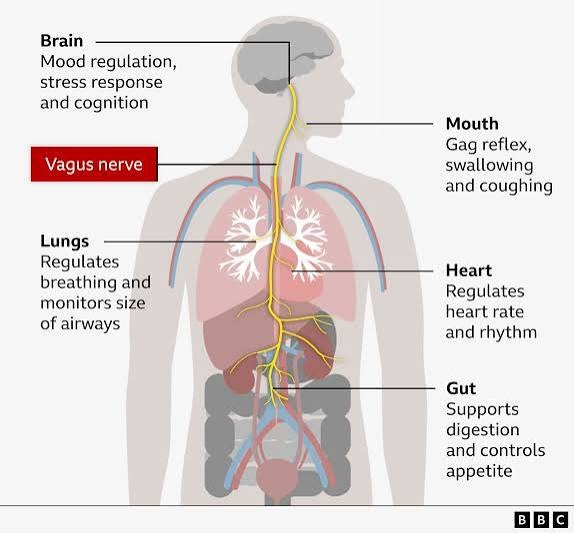
A lot of the modalities for improving vagal tone are obvious, and we’ve covered them before. Getting enough sleep, regularly moving your body, being outside in nature, these are all on the list. But there are a few slightly less obvious ones I want to highlight.
Social connection: Connection may be one of the oldest nervous system regulation tools we have. It makes sense when you consider we evolved for this kind of thing. (I also don’t think it’s a coincidence we’re seeing historic levels of anxiety and depression at a time when modern technology, hyper-individualism, and political polarization have driven us apart.)
After neglecting this part of my life for way too long, I have, in recent years, done a lot of work to boost my “social fitness.” There is evidence that warm, trusting connection—eye contact, affectionate touch, laughter, feeling understood, etc.—may support parasympathetic regulation. But you don’t have to do it because it might impact your physiology; do it because it’s fun. (If you feel like you don’t know anybody to hang out with, try volunteering for a cause you care about. It’s a great way to meet people.)
Social connection will be a major theme in my next book, which I am, finally, nearly finished writing. (Much more on this very soon.)
Hot and cold. Getting in a sauna for 15 minutes a few times a week may support relaxation and recovery pathways. There’s also a ton of hype around cold plunges. If, like me, you find sitting in a cold bath to be deeply unattractive, you can just briefly stand in a cold shower. After a recent interview with an expert on the vagus nerve, I’ve started finishing my daily showers with 15 seconds of cold. Apparently, it might be important to let the water hit your face. I’m trying to build up to 30 or 60 seconds, where the impact may be stronger. It definitely feels good when it’s over!
Deep breathing and meditation. This one is pretty obvious to readers of this newsletter, but bear with me… You’ve all heard me hammer on about meditation, I’ve been doing so for more than a decade. But there’s evidence to suggest it not only helps you disentangle from your thoughts, but also benefits your nervous system.
In recent years, I’ve been pairing meditation with deep breathing. I start my sessions with a minute or two of straw breathing, where you take a deep inhale through the nose and then a really long exhale through the mouth, with the lips pursed as if you’re blowing through a straw.
One important note: many of these practices may help regulate the nervous system in the moment; whether they literally increase “vagal tone” over time is a harder scientific question.
If you want to learn more about how to improve your vagal tone, check out my new podcast episode with Kevin J. Tracey, a neurosurgeon and researcher, who is refreshingly skeptical of influencer claims. (FYI, Tracey’s major breakthrough was helping establish that this nerve acts like the “brakes” for your immune system, sending electrical signals that can turn off dangerous, chronic inflammation. Fascinating stuff.)
Also out is my episode with meditator and mystic Rosa Lewis on how to relax the need to control everything.
Over on the 10% with Dan Harris app:
Join Teacher of the Month Susa Talan tomorrow (Tuesday, April 28 at 4 p.m. ET) for a live meditation and Q&A on Zoom. Drop your questions for her in the event post on the app here.
Upcoming events in person:
As mentioned above, on May 17 come see me at 92NY: tickets here.
Tickets for the next Meditation Party are available here! Jeff Warren, Sebene Selassie, and I are doing another version of our annual retreat this Oct. 16-18. It’s at the Omega Institute in upstate NY. Think four big sessions of meditation, conversation, and Q&A—with plenty of free time to hike the 240-acre campus, play some pickleball, shoot hoops, or just relax by the lake. You can also drop into yoga or tai chi classes, and on Saturday night there’s even a dance party (totally optional, I promise).
Paid subscribers to the new 10% with Dan Harris app get:
Guided Meditations: A library of guided sessions to help with stress, anxiety, focus, sleep, annoying people, and more.
Meditation Challenges: Structured programs to deepen your practice with clear goals, daily guidance, and community support.
Live Meditation and Q&A Sessions: Every week, meditate live with me and some of the best meditation teachers on earth. Ask questions. Get actual answers.
The 10% Happier Podcast: Subscribers get access to ad-free versions of my pod. Both the new episodes and the entire archive, stretching back almost 10 years.
Community Connection: Join conversations with thousands of other practitioners who get it. Share your struggles, celebrate wins, get support when you need it.
Join the party.