

Why you can’t force yourself to sleep
and what to do instead

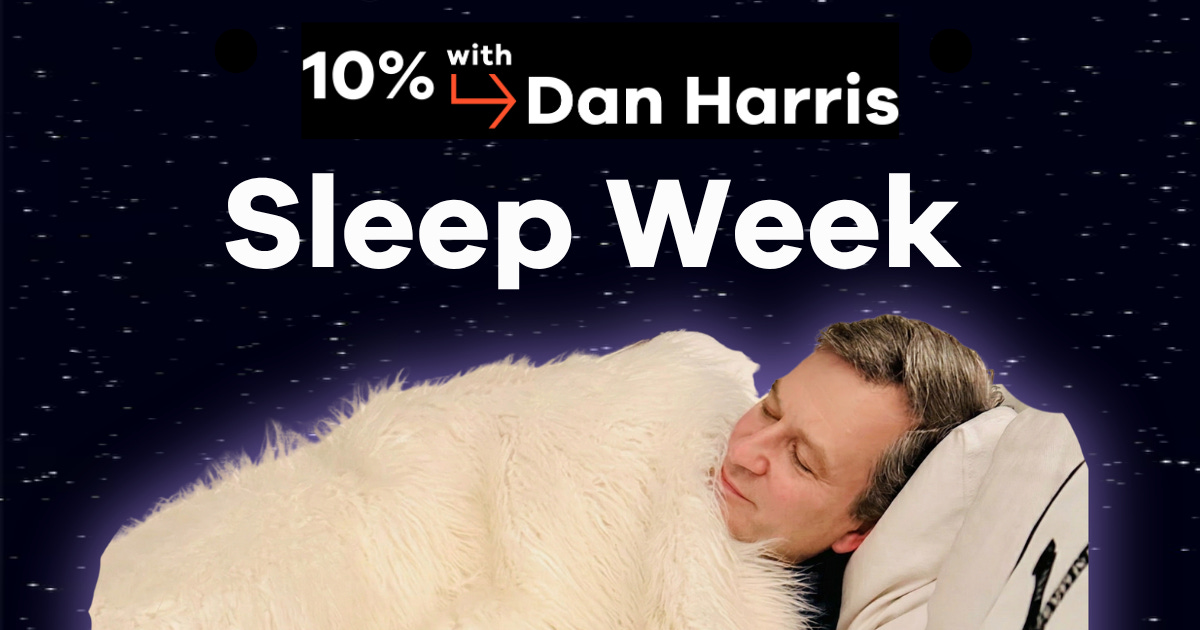
Sleep Week begins next Sunday, May 10, exclusively in the 10% with Dan Harris app. Start your free 14-day trial here to get access to all 10 new sleep meditations and our live events.
Ever since we launched the 10% with Dan Harris app, one of the most consistent pieces of feedback we’ve heard is that you want more tools to navigate the night. We’ve been listening.
Everyone knows sleep is crucial for health, feeling good, and being your best self at home and at work. And unlike other health drivers like diet and exercise which require a certain amount of self-discipline to execute, most people actually want to sleep. It’s one of the few truly healthy things we’re genuinely motivated to do for ourselves.
And yet, for so many of us, sleep remains elusive.
The problem is that sleep is a bottom-up process, not a top-down one. You can’t white-knuckle your way into unconsciousness. It’s a classic Catch-22: the harder you try to sleep, the more the “efforting” mind kicks into gear, making sleep even more impossible…
Next week, May 10 through May 15, is Sleep Week
Sleep Week is our answer: six days of sleep-focused content, 10 new sleep meditations added to the library, a special live session, podcast episodes featuring some of the world’s leading sleep experts, and a community coming together around something we all could use a little more of.
It kicks off Sunday, May 10, which happens to be Mother’s Day. Because if there’s one gift every mom (and, frankly, every human) could use right now, it’s a good night’s sleep.
How to Join Sleep Week
If you’re already a subscriber to the app, you’re all set. Everything will drop automatically into your feed starting May 10.
If you’re not yet a subscriber, now is the time to sign up. We’re offering a 14-day free trial so you can experience the entirety of Sleep Week, access the 10 new sleep meditations, and join the live Q&A.
And if you want to hook Mom up with better sleep for Mother’s Day, we are now offering gift subscriptions. Email support@danharris.com to make a purchase.
I hope you’ll join us.
Xx,
Dan
This is a small contribution to this discussion from a meditation, yoga, and elementary special needs teacher:
Insomnia: Nights Without Rest
Insomnia has been a persistent challenge in my life. During periods of elevated mood, my mind continues long after the lights go out. I can lie in bed exhausted yet intensely alert, as if my brain were powered by a generator with no off switch. Thoughts accumulate—projects, regrets, conversations, plans—each one vivid and insistent. The body calls for rest, but the mind does not comply.
In earlier years, I approached insomnia as a problem to defeat. I would lie awake, frustrated by my inability to relax, watching the hours pass and anticipating the fatigue of the next day. I judged myself, assuming a lack of discipline or calm was to blame. That judgment only compounded the tension, making sleep even more distant.
Over time, my understanding shifted. I began to see sleeplessness during high moods or anxious times not as a failure, but as the result of interacting forces: brain chemistry, emotional fluctuation, stress, and ingrained patterns of thought. Recognizing this did not make restless nights easier, but it reduced the added burden of self-criticism.
One night stands out. After hours of restlessness, I found myself fixated on the coming day—how I would function as a classroom teacher of kids with severe behavior issues with no sleep. The anxiety intensified the wakefulness. Then a simple recognition emerged: this state had causes beyond my immediate control. The racing thoughts, the tension in my body, the worry about tomorrow were all part of a larger process. That realization softened my resistance. I stopped trying to force sleep. Instead, I sat up, turned on a dim light, and read. Eventually, I drifted into a brief rest before morning. The day was still difficult, but it carried less strain.
Another time, during a prolonged stretch of heightened energy, I slept only a few hours each night for nearly a week. By the fourth day, I felt both wired and depleted. Rather than turning against myself, I acknowledged the situation plainly: this is what my mind and body are doing right now. I shifted my focus to small, manageable actions—walking quietly at night, drinking herbal tea, breathing slowly, watching the sky. These actions did not cure the insomnia, but they changed my response to it. Often, that shift made space for a few hours of rest.
Insomnia is not limited to mood-related conditions. It affects many people, driven by anxiety, discomfort, overstimulation, or modern routines that strain the nervous system. What often worsens it is the added layer of blame—questions like “Why can’t I sleep?” or “What’s wrong with me?” That internal pressure becomes part of the problem.
Managing insomnia has meant moving away from control and toward acceptance. Practical steps still matter—consistent routines, a calm environment, meditation—but they are not guarantees. When they fail, the absence of self-blame makes the experience more bearable. Insomnia remains difficult, but without the added weight of judgment, the night becomes less of a struggle. In that easing, rest sometimes comes on its own.
by Gary Halperin ( www.MeditateRelaxRepeat.com )
Binaural beats with headphones (typically)since 2002 have seemed to be significantly helpful to help me initiate sleep. Now I combine those with the Luminate app and Nova mask, not only for sleep, but for mid-day and late evening mindful meditations too.